

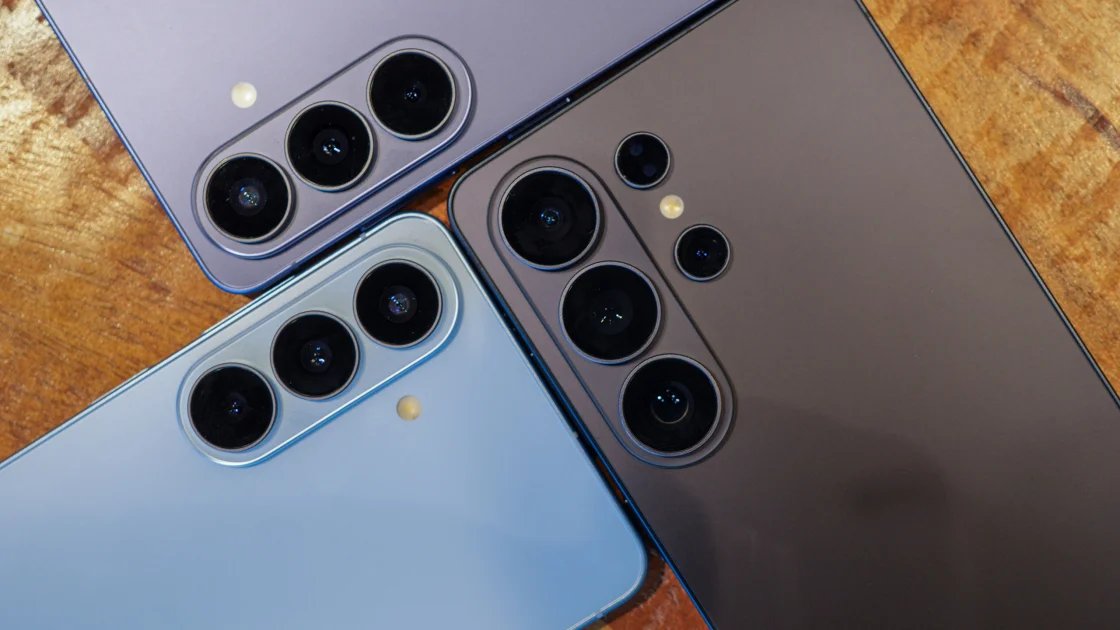
SAN FRANCISCO—Samsung introduced three new phones at Galaxy Unpacked today, and I had a chance to check them all out. The Galaxy S26, S26+, and S26 Ultra pick up where last year’s excellent S25 series left off with quicker processors, smarter AI, more capable cameras, and upgrades to just about everything else, including a new kind of display technology. These phones go head-to-head against Apple’s iPhone 17 series and Google’s Pixel 10 family—some of the industry’s best. Did Samsung take the S26 far enough to hold off the competition?
Here are my early hands-on impressions of and thoughts about the Galaxy S26.
A (Mostly) Unified Design
Thank goodness Samsung has sorted this one out. Since the Galaxy S22 series, the Ultra model has had a different design from the standard and Plus models. It’s been blockier, with sharp corners where the other two have featured cleaner, rounded shapes. Samsung (literally) smoothed everything out for the Galaxy S26 phones, which have the same basic shapes and curves. In other words, they finally all look alike, and this makes me happy.
The three phones even share their color palettes: Black, Cobalt Violet, Sky Blue, and White. The special-edition Silver Shadow and Pink Gold will be available when you buy from Samsung.com.
Left to right: Galaxy S26 Ultra, S26+, and S26 (Credit: Eric Zeman)
They are handsome, simple designs that hew closer to what we’ve seen from Apple iPhones and Google Pixels in recent years. As we’ve come to expect, the phones are made from metal and glass. Samsung says it reverted to Armor Aluminum for all three devices (the S25 Ultra has a titanium frame). Aluminum is more easily shaped, painted, and recycled, and is lighter than titanium yet still strong. The Ultra model has Corning Gorilla Armor 2 protecting the display, while the other two models stick with the first-generation Gorilla Armor. Samsung doesn’t make any specific durability claims beyond meeting the IP68 standard for dust and water resistance.
Left to right: Galaxy S26, S26+, and S26 Ultra (Credit: Eric Zeman)
The metal and glass join cleanly along the straight edges. I like the semi-grainy matte finish of the rear panel glass and outer frame. It feels less slippery than other finishes, isn’t reflective, and doesn’t collect finger oil as readily.
Galaxy S26 Ultra bottom edge (Credit: Eric Zeman)
There are no surprises as you trace the outer frame with your finger. The power button and volume toggle live on the right edge. These are the only two buttons, and they work very well. No functional elements are built into the left rail or top edge, but the bottom holds the USB-C port, a down-firing speaker, the physical SIM card tray, and the S Pen (Ultra model only).
Left to right: Galaxy S26 Ultra, S26+, and S26 (Credit: Eric Zeman)
Samsung didn’t hold back with the camera modules. It has stuck with the vertical lens arrangement for years, and they protrude more than ever on the S26 series. In fact, none of the phones sit flat when placed on a hard surface, such as a table. This means they wobble around. You’ll need a case to solve that pain point. The Ultra model stands out from the other two thanks to its additional lens and sensor, which are set apart from the main module.
Speaking of the Ultra, yes, it still has an S Pen, though it feels like a leftover feature from yesteryear at this point. Samsung didn’t introduce any new features for the S Pen, and in fact, took some away. For example, the S Pen’s button no longer triggers the camera or advances your PowerPoint slides. Pity the S Pen proponents.
Modern phone design has come as far as it can with current materials and engineering requirements. That means we get phones that mostly look the same each year. The Galaxy S26 series may look familiar, but these phones feel great to hold and use, and are well-made.
The Privacy Display Gives the Ultra an Edge
The basic specs for the phones’ displays are hardly changed from the S25 series. Samsung makes fantastic screens, and each phone has a Super AMOLED 2X display that dazzles. They’re all pixel-rich, bright, sharp, fast, and now support 10-bit color (that’s 1 billion individual colors per pixel). Neat. Doomscrolling never looked so good.
Left to right: Galaxy S26 Ultra, S26+, and S26 (Credit: Eric Zeman)
Only the Ultra Model has what Samsung is calling the Privacy Display. This isn’t a software feature; it’s a hardware feature and introduces a new design, says Samsung. Thanks to a new angled-pixel arrangement, Samsung can keep one pixel dark while keeping the adjacent one lit. They are at slight angles to one another. The effect is that, when viewed from the side, the pixels appear dark and the screen looks grayed out. It’s like a stick-on privacy protector, but built into the display itself. You have to enable it via the swipe-down control center. It’s pretty neat, especially if you have to view sensitive material, like the nuclear codes or the formula to Coke, in public.
Get Our Best Stories!
A Smart, Bold Take on the Wireless World
Sign up for the Fully Mobilized newsletter to get our top mobile stories delivered right to your inbox.
Sign up for the Fully Mobilized newsletter to get our top mobile stories delivered right to your inbox.
By clicking Sign Me Up, you confirm you are 16+ and agree to our Terms of Use and Privacy
Policy.
Thanks for signing up!
Your subscription has been confirmed. Keep an eye on your inbox!
AI Galore
Samsung said it wants the Galaxy S26 series to be an “effortless AI phone.” I don’t know about effortless, but it’s certainly chock full of AI.
A lot of the AI is baked into the camera. The standouts are the revised Nightography mode and Super Steady Video capture with horizon lock.
Left to right: Galaxy S26 Ultra, S26+, and S26 (Credit: Eric Zeman)
The processor’s improved NPU architecture has introduced a generational leap in Nightography results. They are cleaner, sharper, and more vibrant. Samsung says the software now proactively recognizes and reduces noise with greater precision. The results I saw in person were striking.
Recommended by Our Editors
“It’s like having a gimbal in your pocket.” That’s what Samsung said of its new horizon lock tool. After the demo I witnessed, I can report that Samsung is not exaggerating. You have to enable it in settings, but the S26 phones can use their 8K-capable sensor to lock on the horizon, no matter how you hold or move the phone. On-site, a Samsung rep spun the phone 360 degrees around, and the horizon in the resulting footage remained perfectly level. It takes practice to get results this good using a gimbal. These phones are going to breed a new wave of action videographers.
AI is also targeting selfies, cleaning up lighting and skin tone, auto-framing when shooting video, and preserving original video quality even after multiple edits.
Galaxy S26 (Credit: Eric Zeman)
Samsung made a big deal about Photo Assist, which it is cribbing from Google. With this tool, you can edit any picture in your photo library by telling the software what to do. When enabled, you can type or speak “change the shirt color to blue,” or “put a green baseball hat on my head,” or “replace the background with the Chicago skyline,” and the app does it. It’s relatively quick, and the results are not only fun but surprisingly well done. It can even change the time of day. Missed Golden Hour at the beach? With the S26 in your pocket, no, you didn’t.
Other features include the Now Nudge, which suggests actions based on the context of your messages (such as booking a lunch date), and a more personal Now Brief, which culls information based on your Personal Data Engine.
Galaxy S26+ (Credit: Eric Zeman)
Then there’s Bixby. Yes, that old on-device assistant is still kicking and, in fact, gaining new code and capabilities, thanks to Gemini and ChatGPT. It’s now an agentic tool that can interact with third-party apps (starting with Uber) and can take actions on your behalf. Dig it: You can call up Bixby and say, “Bixby, book me a ride to the library with Uber.” Bixby will open Uber, enter your location and request, search for rides, and present you with a list of options to take action. Samsung didn’t say how quickly it will add this type of agentic action to more third-party apps. (If this sounds familiar, Rabbit was doing it two years ago with its R1 AI device.)
Preorders Start Now, My Friend
What are you waiting for? Samsung, Best Buy, Amazon, and your favorite wireless carriers are all waiting to take your order. The S26 starts at $899.99, the S26+ starts at $1,099.99, and the S26 Ultra starts at $1,299.99. Those prices are for the base models with 256GB of storage and 12GB of RAM. Deals and savings abound, especially if you order directly from Samsung. The phone hits store shelves on March 11, by which time we expect to have a full review ready for you to read.
About Our Expert
Eric Zeman
Managing Editor, Consumer Electronics
Experience
I’m PCMag’s managing editor for consumer electronics content, overseeing an experienced team of reviewers and product testers. I’ve been covering technology for about 25 years. Prior to PCMag, I worked at outlets such as Android Authority, Fortune, InformationWeek, and Phonescoop.
Read Full Bio
