

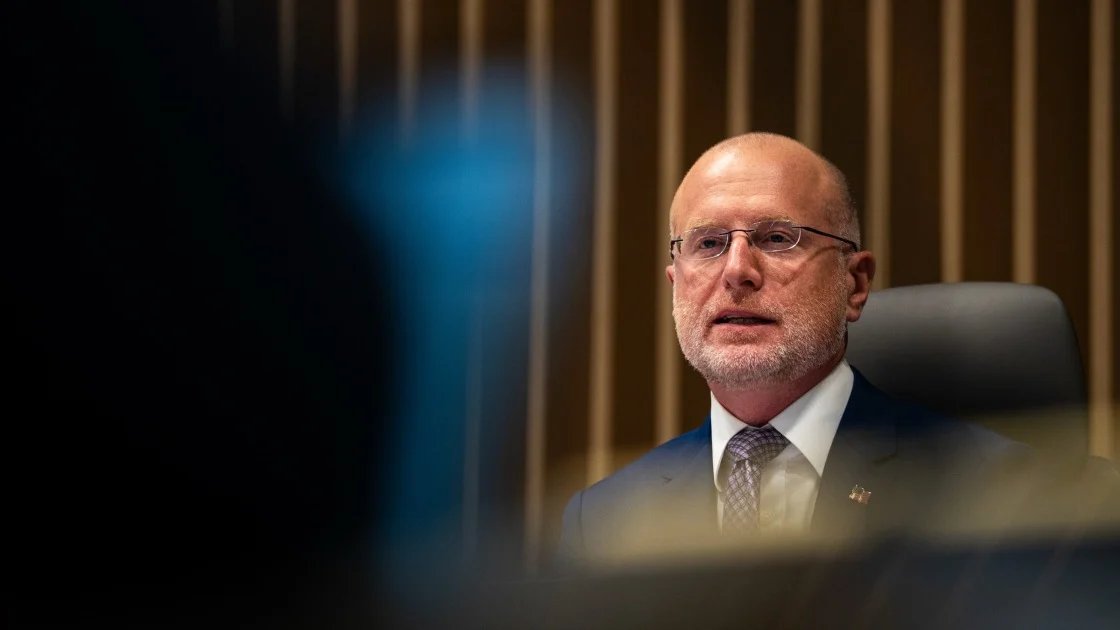
In a rare public rebuke, the chairman of the Federal Communications Commission used social media to criticize Amazon for opposing SpaceX’s orbital data center plan.
Brendan Carr took aim at Amazon after it filed a 17-page document urging the FCC to deny SpaceX’s plan to deploy up to 1 million satellites. According to Carr, Amazon lacks standing to criticize SpaceX because Amazon’s Starlink competitor, Leo, has faced several delays and has only about 200 satellites in orbit, far short of the 1,600 it needs to meet a July FCC deadline.
“Amazon should focus on the fact that it will fall roughly 1,000 satellites short of meeting its upcoming deployment milestone, rather than spending their time and resources filing petitions against companies that are putting thousands of satellites in orbit,” Carr tweeted.
This Tweet is currently unavailable. It might be loading or has been removed.
The scolding is surprising since the FCC usually doesn’t comment on pending satellite applications. Carr’s tweet might also raise concerns about the FCC’s bias toward Elon Musk’s company. SpaceX’s VP for Satellite Policy, David Goldman, has even retweeted Carr’s post.
Amazon didn’t immediately respond to a request for comment. But the company told the FCC last week that it should deny the 1 million-satellite plan because the proposal lacks technical detail, appears speculative, and could give SpaceX a vast foothold in satellite orbits.
SpaceX’s plan for up to 1 million satellites has also triggered astronomers, anti-light pollution groups, and other satellite rivals to protest, urging the FCC to deny the proposal. Concerned citizens have flooded the FCC’s filing system with over 1,400 comments.
Carr’s pushback is also notable since Amazon has formally requested that the FCC grant it an extension or waive the July deadline for the first-generation Leo system. If the company doesn’t meet the threshold, then it risks losing the authority to launch and operate more satellites for the first-generation constellation.
Amazon expects it’ll only have about 700 satellites in orbit by mid-summer, but the company told the FCC it’s invested billions in securing rocket launches through 2029.
Recommended by Our Editors
However, SpaceX has criticized Amazon’s request for an extension, arguing the FCC should avoid offering special treatment. In a new regulatory filing this week, it took another shot at Amazon and its criticism of SpaceX’s orbital data center plan.
“Somehow, Amazon failed to mention that over the past six years, it launched barely 6% of the satellites that it pressured the Commission to approve ahead of its competitors,” Goldman wrote. “Yet, instead of launching satellites since pushing the Commission to give it a license, Amazon consistently attempted to block its competitors from seeking milestone extensions while making the repeated false promise that it would meet its own obligations.”
In the meantime, the FCC granted approval for Amazon Leo’s second-generation system last month, allowing it to operate an additional 4,504 satellites.
Get Our Best Stories!
Your Daily Dose of Our Top Tech News
Sign up for our What’s New Now newsletter to receive the latest news, best new products, and expert advice from the editors of PCMag.
Sign up for our What’s New Now newsletter to receive the latest news, best new products, and expert advice from the editors of PCMag.
By clicking Sign Me Up, you confirm you are 16+ and agree to our Terms of Use and Privacy
Policy.
Thanks for signing up!
Your subscription has been confirmed. Keep an eye on your inbox!
About Our Expert
Michael Kan
Senior Reporter
Experience
I’ve been a journalist for over 15 years. I got my start as a schools and cities reporter in Kansas City and joined PCMag in 2017, where I cover satellite internet services, cybersecurity, PC hardware, and more. I’m currently based in San Francisco, but previously spent over five years in China, covering the country’s technology sector.
Since 2020, I’ve covered the launch and explosive growth of SpaceX’s Starlink satellite internet service, writing 600+ stories on availability and feature launches, but also the regulatory battles over the expansion of satellite constellations, fights with rival providers like AST SpaceMobile and Amazon, and the effort to expand into satellite-based mobile service. I’ve combed through FCC filings for the latest news and driven to remote corners of California to test Starlink’s cellular service.
I also cover cyber threats, from ransomware gangs to the emergence of AI-based malware. Earlier this year, the FTC forced Avast to pay consumers $16.5 million for secretly harvesting and selling their personal information to third-party clients, as revealed in my joint investigation with Motherboard.
I also cover the PC graphics card market. Pandemic-era shortages led me to camp out in front of a Best Buy to get an RTX 3000. I’m now following how President Trump’s tariffs will affect the industry. I’m always eager to learn more, so please jump in the comments with feedback and send me tips.
Read Full Bio
